

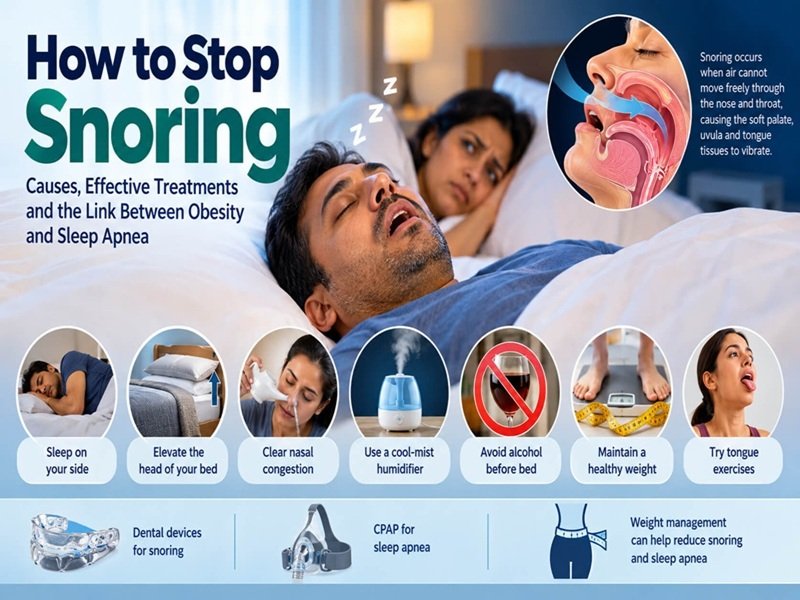
How to Stop Snoring: Causes, Effective Treatments and the Link Between Obesity and Sleep Apnea
Snoring is often treated as nothing more than an irritating nighttime sound. But frequent, loud snoring can sometimes be more than a nuisance. It may indicate that the upper airway is becoming partially blocked during sleep and, in some people, can be associated with obstructive sleep apnea (OSA).
Snoring can have many causes. Sleeping position, nasal congestion, alcohol, certain medications, anatomy and excess body weight can all contribute. In people living with obesity, the risk of sleep-disordered breathing can be particularly important because excess tissue around the upper airway can contribute to airway narrowing.
At Dr. Nirupam Obesity Clinic, the approach to obesity is not limited to weight reduction alone. The clinic focuses on personalized weight management and metabolic health, with options including nutritional counselling, metabolic assessment, non-surgical weight-loss treatments and bariatric surgery when appropriate.
This article explains what causes snoring, what you can do at home, when weight management may help, and when snoring should be investigated for sleep apnea.
What Exactly Causes Snoring?
Snoring occurs when airflow through the upper airway becomes restricted during sleep.
As the muscles of the throat relax, structures such as the soft palate, uvula and tongue can move closer together. Air passing through the narrowed airway causes these tissues to vibrate, producing the sound known as snoring.
The severity of snoring can vary from occasional, relatively quiet snoring to very loud nightly snoring.
Common factors associated with snoring include:
-
Sleeping on the back
-
Nasal congestion
-
Allergies or other causes of nasal obstruction
-
Alcohol consumption before bedtime
-
Smoking
-
Certain sedative medications
-
Excess body weight
-
Anatomical narrowing of the nose or throat
-
Enlarged tonsils or other upper-airway tissues
-
Obstructive sleep apnea
Therefore, there isn't one universal "snoring treatment." The most effective approach depends on the underlying cause.
Is Snoring Related to Obesity?
It can be.
Excess body fat, particularly around the neck and upper airway, can contribute to narrowing of the airway during sleep. When the airway becomes narrower, airflow can become more turbulent and the surrounding tissues may vibrate more easily.
Obesity is also an important risk factor for obstructive sleep apnea, a condition in which the upper airway repeatedly becomes partially or completely blocked during sleep.
This is why persistent snoring in a person with obesity should not automatically be dismissed as a simple sleeping habit.
However, it is equally important to understand that not everyone who snores has obesity, and not everyone with obesity snores.
Snoring should therefore be evaluated according to the individual's symptoms and risk factors.
Can Losing Weight Reduce Snoring?
For people whose snoring or sleep apnea is associated with excess weight, weight reduction may help reduce airway obstruction and improve sleep-related breathing.
The amount of improvement varies from person to person.
A sustainable weight-management plan can include:
-
Nutrition counselling
-
Regular physical activity
-
Behaviour and lifestyle modification
-
Medical weight-management treatment when appropriate
-
Monitoring of metabolic health
-
Bariatric procedures for appropriately selected patients
At Dr. Nirupam Obesity Clinic, weight management is approached on an individualized basis. The clinic provides nutritional counselling, metabolic testing and analysis, non-surgical weight-loss treatments and surgical weight-loss options depending on the patient's health status and goals.
The important point is that snoring should not be treated as a reason to pursue weight loss alone. If sleep apnea is suspected, it needs appropriate evaluation and treatment.
8 Practical Ways to Reduce Snoring
1. Sleep on Your Side
Sleeping on your back can allow the tongue and soft tissues of the throat to move backward and narrow the airway.
For some people, simply changing sleeping position can significantly reduce snoring.
Try:
-
Sleeping on your side
-
Using a body pillow
-
Using a positional sleep device
-
Using a suitable wedge pillow
If your snoring is substantially worse when you sleep on your back, positional therapy may be particularly useful.
2. Elevate the Upper Body
Some people find that sleeping with the upper body slightly elevated reduces snoring.
An adjustable bed or properly designed wedge can be preferable to simply stacking several pillows under the head.
The goal is to elevate the upper body without forcing the neck into an uncomfortable position.
3. Treat Nasal Congestion
A blocked nose can make it difficult to breathe comfortably through the nose and may contribute to mouth breathing and snoring.
Depending on the cause, options can include:
-
Saline nasal spray
-
Saline nasal irrigation
-
Treatment of allergic rhinitis
-
External nasal strips
-
Internal nasal dilators
-
Medical treatment for chronic nasal obstruction
If using nasal irrigation, always use distilled, sterile, or appropriately boiled and cooled water.
Persistent nasal blockage should be assessed by a healthcare professional, particularly when it is present throughout the year.
4. Avoid Alcohol Close to Bedtime
Alcohol can relax the muscles of the upper airway and may worsen snoring and sleep-disordered breathing.
If you regularly snore, avoiding alcohol close to bedtime may help.
People with suspected sleep apnea should be especially cautious because alcohol can aggravate airway obstruction in some individuals.
5. Be Careful With Sedatives
Certain sleeping pills and sedative medications can increase relaxation of the upper-airway muscles.
If you take a prescribed medication, do not stop it suddenly on your own.
Instead, discuss your medications with your doctor if you have developed loud or worsening snoring.
6. Maintain a Healthy Weight
If you are overweight or living with obesity, achieving a healthier weight may improve snoring and can be particularly important when sleep apnea is present.
But avoid extreme diets or rapid weight-loss programs without medical supervision.
The most useful approach is generally a sustainable plan based on your:
-
BMI
-
Waist circumference
-
Medical conditions
-
Eating patterns
-
Physical activity
-
Metabolic health
-
Previous weight-loss attempts
A personalized assessment is more useful than simply following a generic internet diet.
7. Stop Smoking
Smoking can irritate the upper airway and may contribute to inflammation and breathing problems.
Quitting smoking has broad health benefits and may also help improve airway health.
8. Maintain a Regular Sleep Schedule
Sleep deprivation and irregular sleep patterns can contribute to poor sleep quality and may worsen some people's snoring.
Aim for adequate sleep and maintain reasonably consistent sleeping and waking times.
Can Tongue and Throat Exercises Help?
Oropharyngeal or myofunctional exercises are designed to improve the function and strength of muscles involved in maintaining the upper airway.
Some studies suggest that structured upper-airway exercises may reduce snoring in selected individuals.
Examples include:
Tongue Slide
Place the tip of your tongue against the roof of your mouth and slide it backward along the palate as far as comfortably possible.
Repeat several times.
Tongue-to-Palate Exercise
Press your tongue firmly against the roof of your mouth and hold it for several seconds.
Relax and repeat.
Vowel Exercises
Some structured programs involve repeatedly and deliberately pronouncing vowel sounds such as:
A – E – I – O – U
These exercises are intended to activate muscles around the mouth and upper airway.
However, these exercises should not be considered a replacement for sleep-apnea evaluation when warning signs are present.
What About Anti-Snoring Devices?
Several devices are marketed for snoring, but they don't all work in the same way.
Mandibular Advancement Device
A mandibular advancement device (MAD) holds the lower jaw slightly forward while sleeping.
This can help increase the space in the upper airway and may reduce snoring in appropriately selected patients.
A professionally fitted, adjustable device is generally preferable to an inexpensive generic mouthpiece.
Tongue Retaining Device
A tongue-retaining device holds the tongue in a forward position.
It may be useful for selected people in whom the tongue contributes substantially to airway obstruction.
Nasal Strips and Dilators
These can help some people whose snoring is associated with nasal narrowing.
However, they do not prevent obstruction deeper in the throat and should not be considered a treatment for obstructive sleep apnea.
When Is CPAP Needed?
CPAP (Continuous Positive Airway Pressure) is primarily used for obstructive sleep apnea rather than uncomplicated snoring.
The machine delivers pressurized air through a mask to help prevent the upper airway from collapsing during sleep.
For people diagnosed with obstructive sleep apnea, PAP therapy can significantly improve nighttime breathing and commonly reduces snoring.
If you think you may have sleep apnea, it is better to undergo an appropriate sleep evaluation rather than buying and using a CPAP machine without medical guidance.
Snoring vs Sleep Apnea: What's the Difference?
This is one of the most important distinctions to understand.
Simple snoring
A person may snore loudly but continue breathing normally throughout the night.
Obstructive sleep apnea
The airway repeatedly becomes partially or completely blocked during sleep.
This can result in:
-
Repeated breathing interruptions
-
Oxygen fluctuations
-
Brief awakenings
-
Fragmented sleep
-
Excessive daytime sleepiness
A person may not remember these nighttime awakenings.
In fact, their partner may recognize the problem before they do.
Warning Signs You Should Not Ignore
Talk to a doctor if your snoring is accompanied by:
Loud nightly snoring
Especially when it has become progressively worse.
Breathing pauses
A partner notices that you stop breathing during sleep.
Gasping or choking
You wake suddenly trying to catch your breath.
Morning headaches
Repeated headaches after waking can occur with sleep-disordered breathing.
Dry mouth
Particularly when waking with a very dry mouth on a regular basis.
Daytime sleepiness
You feel unusually tired despite apparently getting adequate sleep.
Poor concentration
Sleep disruption can affect attention, concentration and daytime performance.
Falling asleep while driving
This is a particularly serious warning sign.
If you are struggling to stay awake while driving, do not ignore the symptom.
Who Should Evaluate Persistent Snoring?
Depending on the symptoms, evaluation may involve:
-
Primary care physician
-
Sleep medicine physician
-
ENT specialist
-
Pulmonologist
-
Qualified dental sleep-medicine professional
A doctor may recommend a home sleep apnea test or an overnight polysomnography (sleep study) depending on the individual's symptoms and risk factors.
How Obesity Management Can Fit Into the Bigger Picture
For someone with obesity and loud snoring, treating only the snoring may not address the underlying health issue.
A comprehensive evaluation can look at the person's overall metabolic and weight-related health.
At Dr. Nirupam Obesity Clinic, the website describes a personalized approach to weight management, with services including non-surgical weight-loss treatment, nutritional counselling, metabolic testing and analysis, and bariatric surgery.
The clinic also describes Dr. Nirupam Sinha as a bariatric and metabolic surgeon with qualifications including MBBS, MS (General Surgery), FMBS, FMAS, FIAGES, CICO and FALS (Robotic).
This broader approach is important because a person's snoring, weight, metabolic health and sleep quality can all be relevant when assessing their overall health.
What Should You Do Tonight?
If you want to start reducing snoring immediately, try these simple steps:
Tonight:
-
Sleep on your side.
-
Avoid alcohol close to bedtime.
-
Make sure your nose is not blocked.
-
Get adequate sleep.
-
Avoid unnecessary sedative medication.
-
Consider slight upper-body elevation.
-
Ask your partner whether they notice breathing pauses.
Then observe what happens over the next few nights.
If your partner reports breathing pauses, choking or gasping, don't simply purchase an anti-snoring device. Arrange a medical evaluation for possible sleep apnea.
Frequently Asked Questions
Can obesity cause snoring?
Obesity can increase the likelihood of snoring because excess tissue around the upper airway can contribute to airway narrowing during sleep. However, snoring has many possible causes and can occur in people who are not overweight.
Will losing weight stop snoring?
Weight loss may reduce snoring in people whose snoring is associated with excess weight. The degree of improvement varies and depends on the underlying cause.
Is snoring always sleep apnea?
No. Many people snore without having obstructive sleep apnea. However, loud snoring accompanied by breathing pauses, gasping or excessive daytime sleepiness should be evaluated.
Can sleeping on your side stop snoring?
Side sleeping can reduce snoring in people whose symptoms are worse while sleeping on their back.
Do nasal strips cure snoring?
No. Nasal strips may improve nasal airflow for some people but cannot correct obstruction occurring deeper in the throat.
Can I treat snoring with exercises?
Certain tongue and upper-airway exercises may help selected people, but they are not guaranteed to eliminate snoring and should not replace medical evaluation when sleep apnea is suspected.
Is CPAP used for ordinary snoring?
CPAP is primarily a treatment for obstructive sleep apnea. It should generally not be used simply for ordinary snoring without an appropriate medical assessment.
Final Takeaway
Snoring is not always just a harmless nighttime sound.
For some people, changing sleep position, improving nasal breathing, avoiding alcohol before bedtime and maintaining a healthy weight can make a significant difference.
For people living with obesity, weight management can be an important part of improving overall health and may also help when excess weight contributes to snoring or obstructive sleep apnea.
However, persistent loud snoring combined with breathing pauses, choking, gasping or excessive daytime sleepiness requires more than an anti-snoring remedy. It warrants an evaluation for obstructive sleep apnea.
A personalized approach—looking at weight, metabolic health, sleep symptoms and the anatomy of the airway together—can help identify the most appropriate treatment.
About Dr. Nirupam Sinha
Dr. Nirupam Sinha is a bariatric, metabolic and advanced laparoscopic surgeon associated with Dr. Nirupam Obesity Clinic. The clinic provides personalized obesity and weight-management services, including nutritional counselling, metabolic assessment, non-surgical weight-loss options and bariatric surgery.
For persistent snoring, suspected sleep apnea, or weight-related health concerns, seek an individualized medical assessment rather than relying solely on over-the-counter anti-snoring products.