

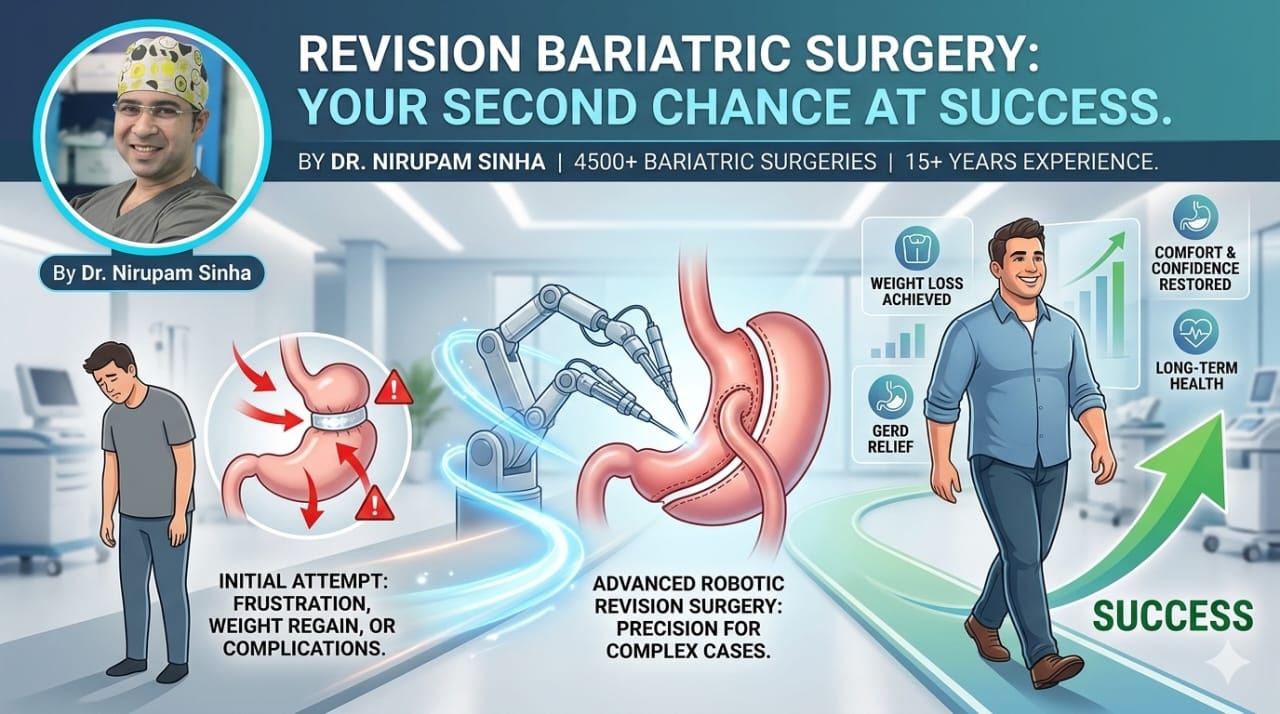
A Second Chance at Success: The Complete Guide to Revision Bariatric Surgery
By Dr. Nirupam Sinha (MBBS, MS – General Surgery, FMBS, FMAS, FIAGES, CICO, FALS – Robotic)
15+ Years Experience | 4500+ Bariatric Surgeries
Introduction: Erasing the Stigma of "Failure"
When a patient comes to me for revision bariatric surgery, they are often carrying a heavy burden of guilt, believing they have "failed" their first procedure. Let me be clear: you did not fail. Bariatric surgery is a powerful tool, but human biology is complex. Over time, anatomical changes, hormonal shifts, or severe complications can compromise the initial results.
Whether you are dealing with debilitating acid reflux, unexpected weight regain, or a procedure that simply didn't work as expected, Revision Bariatric Surgery offers a safe, effective second chance to reclaim your health. With over 15 years of experience and 4,500+ bariatric surgeries performed, my team and I specialize in these complex, corrective procedures to help you safely get back on track.
Why Do Patients Need Revision Surgery?
The need for a second surgery generally falls into two categories: Mechanical/Medical Complications or Metabolic Resistance (Weight Regain).
1. Severe Medical Complications
-
Severe Acid Reflux (GERD): A common issue years after a Sleeve Gastrectomy.
-
Anatomical Issues: Ulcers, strictures (narrowing), or leakage from the original staple line.
-
Severe Nutritional Deficiencies: Sometimes the body stops absorbing vital nutrients properly after a bypass, requiring a surgical adjustment.
2. Weight Regain or Inadequate Weight Loss
-
Stretching: Over time, the stomach pouch or the connection to the small intestine can stretch, allowing you to eat larger portions.
-
Hormonal Adaptation: The body is smart; it can eventually adapt to the initial metabolic reset, leading to increased hunger and plateaued weight loss.
-
Outdated Procedures: Many patients who had Lap-Bands (Gastric Bands) placed 10+ years ago now require conversions due to band slippage or erosion.
The Robotic Advantage in Revision Surgery
Revision surgeries are inherently more complex than primary surgeries because of adhesions (scar tissue) from the first operation.
This is where advanced technology becomes critical. As a specialist in Robotic-Assisted Bariatric Surgery, I utilize the robotic platform to navigate complex scar tissue with unmatched precision. The 3D, high-definition visualization and highly articulate robotic instruments allow me to safely perform intricate corrections that would be exceptionally difficult with standard laparoscopy. This translates to higher safety, less blood loss, and a smoother recovery for you.
Common Revision Pathways: Finding the Right Fix
There is no "one-size-fits-all" revision. The correct approach depends entirely on your original surgery and your current symptoms.
| Your Original Surgery | Your Current Problem | The Likely Revision Solution |
| Gastric Band (Lap-Band) | Band slipping, pain, or weight regain | Band Removal & Conversion to Sleeve or Gastric Bypass |
| Sleeve Gastrectomy | Severe Acid Reflux (GERD) | Conversion to Roux-en-Y Gastric Bypass (The gold standard for curing reflux) |
| Sleeve Gastrectomy | Weight Regain / Stretched Pouch | Re-Sleeve (tightening the pouch) or Conversion to Mini-Gastric Bypass |
| Gastric Bypass | Stretched pouch / Weight regain | Pouch Resizing or altering the intestinal bypass length |
The Pre-Surgery Evaluation: Measuring Twice, Cutting Once
Because you have already had surgery, we cannot simply guess what is happening inside. A comprehensive pre-surgical evaluation is mandatory to ensure your safety:
-
Endoscopy (UGI): A camera is used to physically look inside your stomach to check for stretching, ulcers, or hernias.
-
Barium Swallow / CT Scans: To map out your current digestive anatomy.
-
Nutritional Blood Panels: To ensure you are medically fit for a second surgery.
Recovery and Long-Term Success
-
Hospital Stay: Typically 2 to 4 days, depending on the complexity of the revision.
-
Recovery: Most patients return to their routine within 2 to 3 weeks.
-
The Diet: You will restart the bariatric diet phases (Liquid → Soft → Solid) to allow the new surgical connections to heal perfectly.
Why Trust Dr. Nirupam Sinha for Your Revision?
Revision surgery demands a level of expertise, precision, and anatomical knowledge far beyond standard bariatric procedures.
-
Experience that Matters: 4,500+ successful surgeries mean we have successfully navigated the most complex anatomical challenges.
-
Advanced Technology: Leveraging robotic precision to safely bypass old scar tissue.
-
Zero Judgment: We offer a compassionate, patient-first environment focused strictly on solutions, not assigning blame.
Final Thoughts
If your initial weight loss surgery is no longer serving you, you do not have to live with the discomfort, acid reflux, or frustration of weight regain. Revision bariatric surgery is a highly effective way to hit the reset button. Consult with us today to explore your options and find your path forward.
Frequently Asked Questions (FAQs)
1. Is revision bariatric surgery safe?
Yes. While it carries slightly higher risks (like bleeding or leaks) than a first-time surgery due to scar tissue, having the procedure performed by a highly experienced, high-volume robotic surgeon drastically minimizes these risks.
2. Will I lose as much weight as I did the first time?
Weight loss after a revision is generally slower and slightly less dramatic than after a primary surgery. However, patients still achieve highly significant, health-improving weight loss, alongside the resolution of complications like GERD.
3. Why did I regain weight? Is it my fault?
Weight regain is a complex mix of metabolic adaptation, stomach pouch stretching, and lifestyle factors. It is a known medical possibility, not a moral failure. Our goal is to fix the mechanics so your lifestyle efforts actually work again.
4. Which revision surgery is best for me?
This depends entirely on your previous procedure and current anatomical condition, which we determine through your pre-surgery evaluation.
5. Will my insurance cover a revision?
This depends heavily on your provider and your medical necessity. Revisions done to correct severe medical complications (like severe GERD or ulcers) are frequently covered. Our team will help you navigate the approval process.